Germany's 1,197-Foot Wind Turbine Redefines Renewable Energy
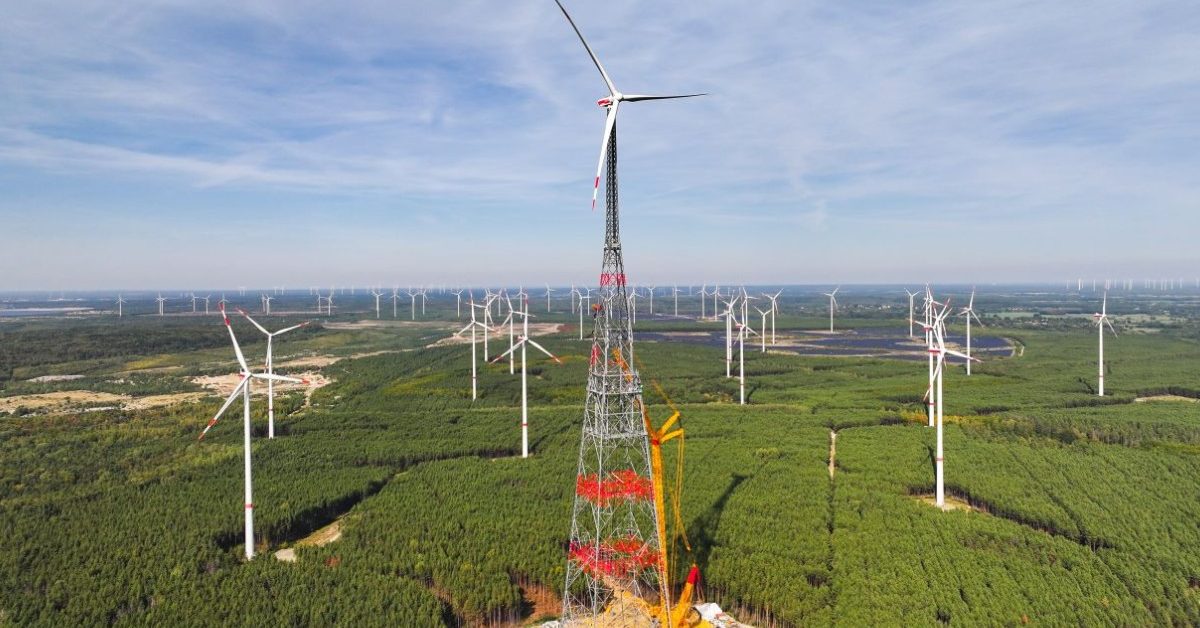
Wind power just got a serious altitude boost. In Schipkau, eastern Germany, a turbine has climbed to 365 meters—1,197 feet—making it the tallest wind turbine on the planet. Developed by GICON for Germany's Federal Agency for Disruptive Innovation (SPRIND), this pilot project isn't just a height record; it's a test of whether higher winds can deliver dramatically more electricity. With commissioning set for November, the real question is whether the projected doubling of output holds up in operation. If it does, it could reshape how we think about wind farm density and energy yield.
The Engineering Behind the Height
Reaching 1,197 feet isn't as simple as ordering a taller crane. GICON used a telescoping tower design: a specialized lifting system raised the inner tower through a surrounding lattice structure, then secured it in place. This approach sidesteps the need for a crane capable of reaching the full height, which would be impractical and costly. The rotor hub sits 300 meters (984 feet) above ground, and the turbine has a rated capacity of 3.8 MW. Future versions are planned to exceed 7 MW. The project was built for SPRIND, and official commissioning is slated for November, with final work still to be completed.
Why Higher Altitudes Matter
Winds at higher altitudes are stronger and more consistent, giving the turbine more opportunities to generate electricity. GICON says its design could produce approximately twice as much energy as a conventional turbine with the same rotor diameter. That doubling refers to electricity generated over time, not a doubling of rated power. The implication is significant: existing wind farms might not need new land to boost output. GICON and SPRIND envision adding these taller turbines as a 'second tier,' with rotors operating above conventional ones. Their current assessment suggests Germany's existing wind farms could potentially accommodate up to 4,000 high-altitude turbines—an estimate, not a construction pipeline.
What's Next: Pilot to Production
The Schipkau turbine is still a pilot, and its projected energy yield has yet to be demonstrated in operation. GICON and SPRIND are preparing to scale up the design and are discussing commercialization with interested wind energy companies. Their goal is to begin series production as quickly as possible. But first comes commissioning, and then they'll see how much electricity the world's tallest wind turbine actually delivers. If the numbers hold, this could offer a new path to denser, higher-output wind farms without expanding into new areas—a critical advantage as land use and grid connection become tougher challenges globally.
Key Takeaways
- GICON's pilot turbine in Schipkau, Germany, stands 365 meters (1,197 feet) tall, making it the world's tallest wind turbine.
- The turbine uses a telescoping tower and specialized lifting system to reach its height without a full-height crane.
- Developer claims the design could roughly double electricity output over time compared to a conventional turbine with the same rotor diameter.
- GICON and SPRIND estimate Germany's existing wind farms could potentially host up to 4,000 high-altitude turbines as a 'second tier.'
- Official commissioning is planned for November 2026, and the projected energy yield still needs to be demonstrated in operation.
Keep Reading