Glass Bead Entangled With Light Could Become Quantum Memory
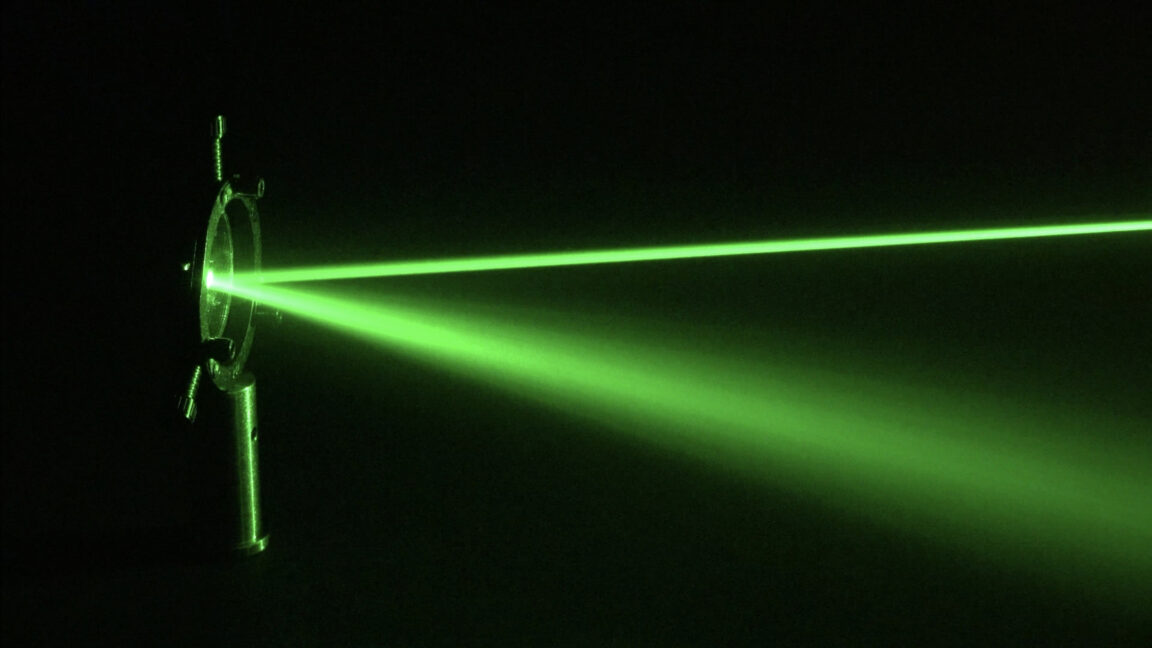
Most quantum entanglement experiments deal with particles so small they barely feel the world around them. A glass bead is the opposite: big enough that its size should destroy any quantum correlation before it can be measured. Yet a team of researchers has now entangled a suspended glass bead with light, according to Ars Technica. The result is a technical tour de force, but it also points toward something practical: a mechanical memory for quantum communications.
How a bead becomes quantum
The setup relies on optical tweezers and an optical cavity. Laser light is confined between two mirrors, creating a standing wave that strongly defines the light fields and their interaction with the bead. The bead is cooled by slightly reddening the laser so it loses energy through the Doppler effect. A second, bluer beam then kicks the bead, and the two light fields become correlated through the bead's motion. That correlation is the entanglement. Because the bead is large, its size would normally wash out quantum effects, making this result unusual.
Why measuring it is so hard
Entanglement cannot be seen directly. In this experiment, a small amount of light leaks from one mirror, escaping the cavity and carrying tiny fluctuations in phase and amplitude tied to the bead's movement. Since both light fields leak, their correlation can be measured, revealing the entanglement with the bead. The measurements are noisy and depend on an excellent model of the whole system to separate entangled from non-entangled states. It is the first measurement of its kind, so better results are expected as the technique matures.
A possible quantum memory
In quantum communications, light is the natural carrier of quantum information, but storing light is difficult. A mechanical system like this could store information locally as a memory. Because it is fully artificial, it can be designed to have exactly the properties needed. That makes it promising for building quantum networks, where information must be held and then moved onto photons. The experiment also reinforces a broader point: quantum mechanics is not confined to exotic particles. It shows up even in a bead of glass.
Key Takeaways
- A glass bead was entangled with two light fields using optical tweezers and an optical cavity.
- The bead was cooled with a redder laser and kicked with a bluer one, correlating the light fields through its motion.
- Leaked light from the cavity revealed the entanglement, though the measurements remain noisy.
- The work suggests a designable mechanical memory for quantum communications.
Source: Ars Technica • 🇺🇸 San Francisco
Keep Reading