1841 Train Delay Was Space Weather—Just 7 Years Off
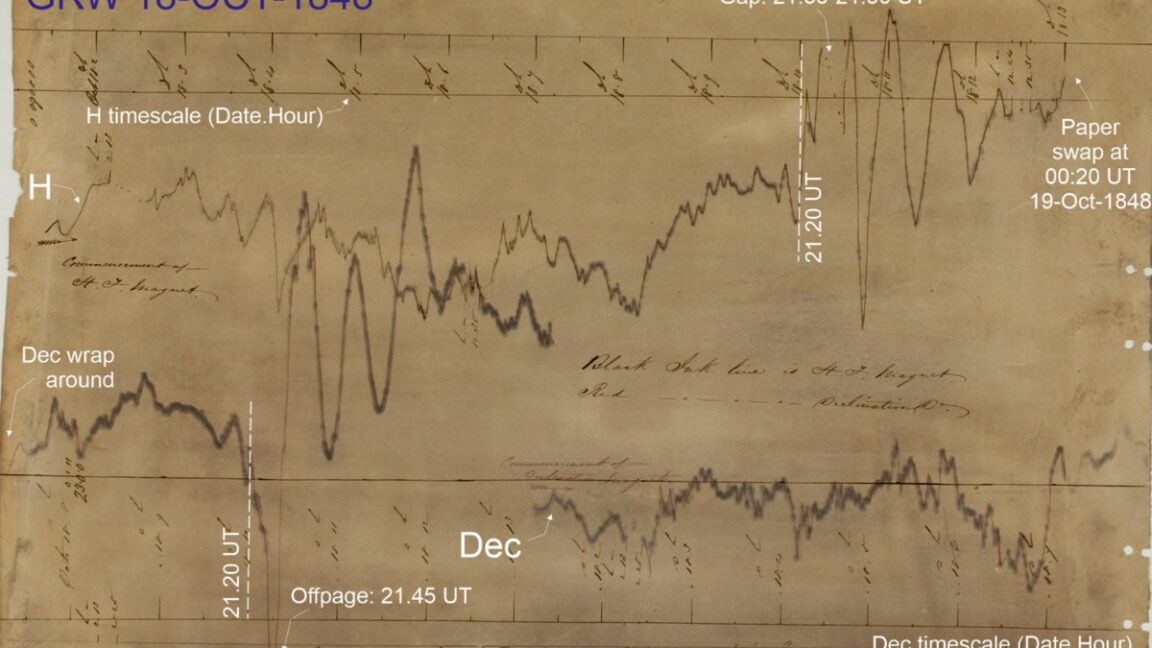
For over a decade, space weather historians thought they had found the earliest case of a geomagnetic storm disrupting technology: an October 1841 train delay in Exeter, England, described in an anonymous 1871 Nature report. But a new study in the journal Space Weather argues the date was a typographical error. The real disruption likely occurred in 1848, and the earliest confirmed incident is now a March 1847 telegraph failure on the Midland Railway. The correction matters because it sharpens the timeline of how long human technology has been vulnerable to solar activity.
The 1841 Report That Didn't Add Up
The anonymous Nature account described a 'very intense magnetic disturbance' on October 18, 1841, that delayed a 10:05 PM express train from Exeter because the telegraph operator could not confirm whether the line was clear. But researchers led by Jim Wild of Lancaster University noticed problems. The report appeared 30 years after the event, the author was unnamed, and the South Devon Railway's Exeter-to-Plymouth line was not approved by Parliament until July 1844 and did not open until May 30, 1846. That made an 1841 delay impossible. The team also found no unusual auroral or magnetic activity in England on that date, according to Greenwich observatory records.
A Typo, a Telegraph Engineer, and a Missing Year
Wild and his co-authors traced the anonymous Nature article to a publisher's copy annotated 'N. [J.] Holmes,' likely Nathaniel John Holmes, a prominent electrical engineer who worked on undersea telegraph cables and lived near Nature editor Sir Norman Lockyer. Holmes had clear interests in solar activity. But the date still did not fit. Archival magnetograms showed strong geomagnetic activity around October 18, 1848, confirmed by newspaper accounts and sunspot observations by British astronomer Temple Chevallier on October 19, 1848. Contemporary railway timetables listed a 10:05 PM express from Exeter between March 11, 1848, and July 26, 1849. The simplest explanation: 1841 was a typo for 1848.
Why the Corrected Timeline Matters
With the 1841 claim ruled out, the earliest documented space weather impact on technology becomes a March 1847 incident in which 'spontaneous electrical currents' disrupted telegraph systems on the Midland Railway while a brilliant aurora glowed over the British Isles. That predates the famous 1859 Carrington Event, which remains the most powerful geomagnetic storm on record and caused sparking and fires in telegraph stations. The correction matters because it shows electrical technology has been vulnerable to solar storms since the telegraph era. A similarly intense storm today could damage power grids and satellite communications, making historical records essential for better predictions.
Key Takeaways
- The 1841 Exeter train delay was likely a typo for 1848, not the earliest space weather disruption.
- The earliest documented case is now a March 1847 telegraph disruption on the Midland Railway.
- Researchers identified the anonymous Nature author as likely electrical engineer Nathaniel John Holmes.
- Greenwich magnetograms and railway timetables confirm strong geomagnetic activity around October 18, 1848.
- Historical space weather records help scientists improve predictions for modern grid and satellite risks.
Source: Ars Technica • 🇺🇸 San Francisco
Keep Reading