Kilauea's 400-Meter Lava Fountains Are Rewriting Volcanology
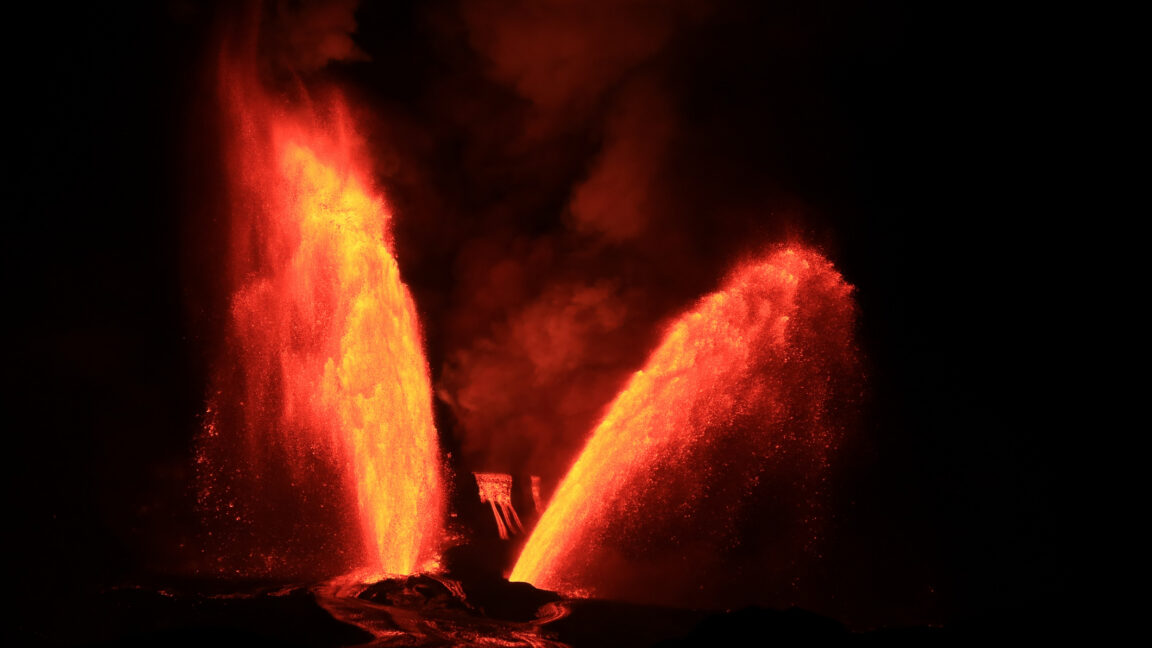
Most volcanic eruptions are slow enough to stroll away from. But at Kilauea, Mount Etna, and Iceland, molten rock has shot hundreds of meters into the sky in fountains that still puzzle scientists. Thanks to an extraordinary run of eruptions at Hawaii's most active volcano, researchers from the US Geological Survey now have the best documentation yet of these violent displays—and a clearer, if incomplete, picture of what powers them.
A Volcano Under a Microscope
Kilauea isn't just dramatic—it's instrumented. Thirty-five data-gathering stations ring the volcano, capturing seismic, infrasound, geodetic, gas, and visual and thermal data. After a major 2018 eruption partly drained an underground lava reservoir, refilling began and then accelerated: the local peak inflated more than 22 cm a year starting in 2019, doubling to 57 cm a year by 2023 and spreading to a nearby caldera. In 2024, earthquakes accompanied a 900-meter fissure that sent fountains 160 meters high for 13 hours, with a second eruption following in under a day. As of last month, 52 more fountain eruptions had occurred, the most violent exceeding 400 meters.
Steam vs. Foam: The Mechanism Debate
Two leading ideas compete to explain fountaining. One holds that pressure keeps water mixed with other materials until magma reaches shallow depths, where it flashes to steam, fragmenting the magma and accelerating ascent in a feedback loop. The alternative invokes carbon dioxide forming a magma/gas foam at the chamber roof that eventually escapes catastrophically. The new data doesn't settle it, but it clearly doesn't favor the CO2 foam model: carbon dioxide levels stayed low throughout the eruption cycle. Sulfur dioxide rose during eruptions and dropped afterward but remained elevated throughout, suggesting continuous gas escape from magma. The evidence leans toward steam-driven eruption, though why a continuous process suddenly triggers fountains remains unclear.
Prediction Breakthrough and Data Gaps
Perhaps the most consequential finding is predictive. Each eruption rapidly deflated Kilauea's summit, followed by slow refilling of the Halemaʻumaʻu magma reservoir. USGS recognized that consecutive eruptions occurred when summit tilt reached similar levels—and while the precise tilt threshold drifted downward over time, the difference between eruptions stayed small. That pattern let the agency issue alerts before eruptions, crucial because there were no clear seismic signals immediately before fountains restarted. Magnesium oxide fluctuations suggest eruptions deplete a reservoir later refilled with hot material, while other oxides rose over time, hinting at distinct chemistry in arriving magma. Researchers acknowledge they'd like more data, but infrared gas sampling is difficult during fountaining, and installing hardware near 400-meter fountains isn't safe. One camera was sacrificed to capture falling semi-molten rock.
Key Takeaways
- USGS researchers used Kilauea's recent eruption sequence to test competing theories of lava fountain formation.
- Carbon dioxide levels stayed low throughout eruptions, weakening the magma/gas foam hypothesis in favor of steam-driven mechanisms.
- Summit tilt patterns allowed USGS to issue eruption alerts despite no clear seismic precursors before fountains restarted.
- Magnesium oxide fluctuations suggest a cycle where eruptions deplete a magma reservoir that is later refilled with hotter material.
- The 2024 fissure eruption sent fountains 160 meters high, with later events exceeding 400 meters.
Source: Ars Technica • 🇺🇸 San Francisco
Keep Reading