Neanderthals Left Wooden Tools in Stone—And a 597-Piece Clue
Stone tools get the headlines, but wood was probably the material early humans reached for most. It just rarely survives. At Abric Romaní, a rock shelter west of Barcelona, calcium-rich water did something unusual: it sealed wooden objects inside a limestone-like crust. When the wood rotted, it left hollow molds that preserve shape down to visible wood-cell outlines. A Spanish team has now cataloged 597 wooden remains from Neanderthal living areas dated 62,000 to 40,000 years ago, and the picture is far more domestic than a hunting camp.
A 20,000-Year Snapshot of Daily Life
Most famous wooden artifacts are weapons pulled from waterlogged sediments where oxygen starvation slowed decay. Abric Romaní is different. It is a place where Neanderthals lived, slept, cooked, and made tools across roughly 20,000 years. Because wood appears in level after level, it points to routine woodworking, not a one-off. Of the 597 remains, most were natural trunks, fallen branches, and firewood, largely Scots pine. Only 13 objects were made or modified by Neanderthals. According to co-author M. Gema Chacón, an archaeologist at IPHES-CERCA, the morphology of those 13 tools is impossible to find in nature.
What the 13 Tools Actually Were
The crafted objects include four shallow juniper-bark trays found near hearths, the largest 55 by 20 centimeters, possibly used to carry food or scoop embers. Crossed poles over a thick hearth may be tripod remains. A branchless pole more than five meters long was found in the innermost part of the shelter, fitting a pattern seen in every level dug so far. Along the back wall, Neanderthals kept small hearths about 50 centimeters across, spaced a meter or so apart, with almost no debris around them. Chacón suspects these were sleeping hearths, providing illumination and protection from carnivores.
The Club, the Spear, and the Wood They Chose
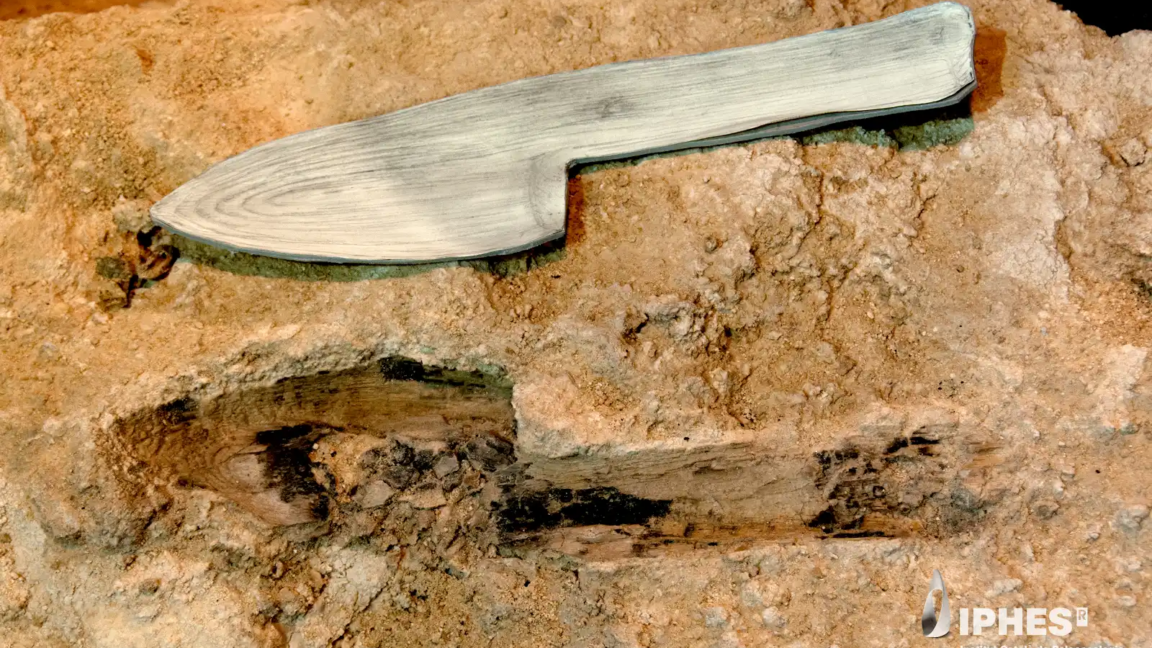
The most surprising find is a club carved from a single piece of wood, with a 16-centimeter handle and a pointed, roughly triangular head about 14 centimeters tall. Where the two meet, an abrupt right-angle step may have kept the hand from slipping. Chacón says nothing quite like it has turned up anywhere. The team also found a pointed stick and two spears near antlered red deer skulls. The best-preserved spear is 2.45 meters long, and a cast of its point shows an impact fracture identical to those on spears used by Aboriginal Australians. Material choices suggest Neanderthals knew their wood: Scots pine is easy to work and dries quickly; juniper bark suited trays; firewood tended dry, tools came from fresh wood.
Why It Matters Beyond One Shelter
The findings add to a broader shift in how Neanderthals are seen. Evidence has piled up that they twisted fibers into cord, made symbolic objects, and interbred with our species. Chacón says Neanderthals are no longer perceived as Homo sapiens' dumb cousins, and suggests Abric Romaní may offer a new perspective for interpreting finds at other sites. But she also worries about what has already been lost. The tools were first described in the 1990s, and it took decades to identify and catalog them. She says colleagues have told her they found something thought to be wood, excavated it, took pictures, but did not keep it. Now they say perhaps it could be a tool.
Key Takeaways
- Abric Romaní's limestone crust preserved hollow molds of Neanderthal wood, including visible wood-cell outlines.
- Of 597 wooden remains dated 62,000–40,000 years ago, 13 were crafted tools; most were natural wood and firewood.
- Finds include bark trays, a possible tripod, a five-meter pole, spears, and a club unlike anything seen before.
- Wood choice suggests planning and material knowledge, not opportunistic scavenging.
- The study raises concerns that similar wood tools elsewhere may have been discarded during excavation.
Source: Ars Technica • 🇺🇸 San Francisco
Keep Reading