Tesla Cybercab Crash in Philly Exposes Its Plastic Body Bet
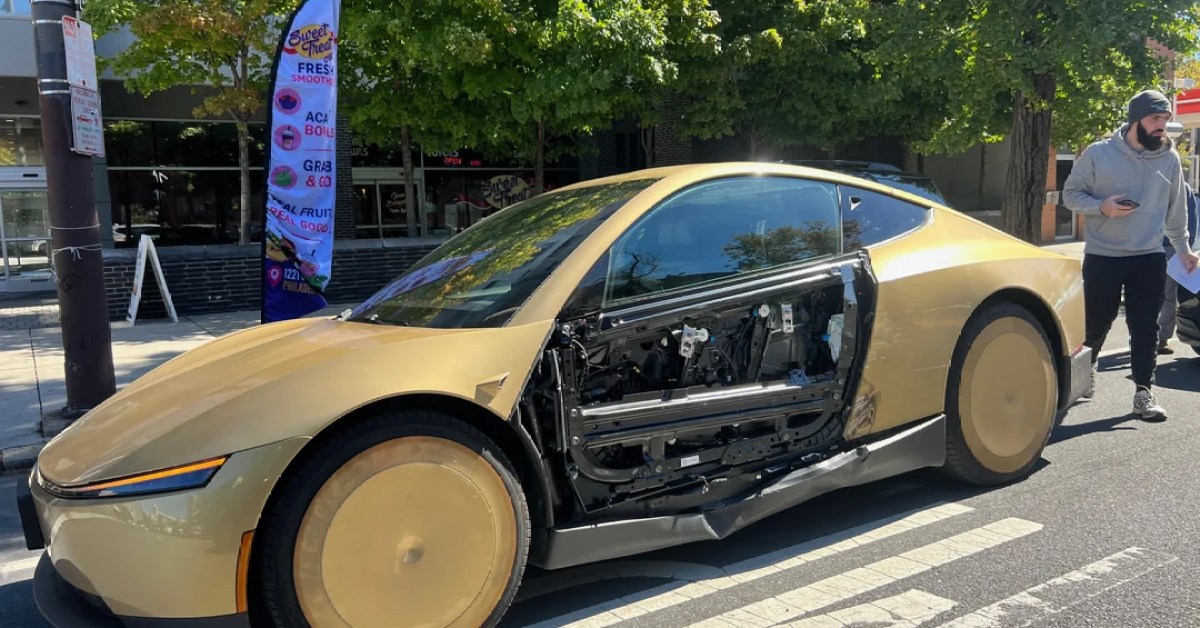
A Tesla Cybercab was photographed on South Broad Street in Philadelphia this week missing the entire outer skin of its driver-side door after a crash. The images, posted by a Reddit user, show exposed inner door frame, window regulator, and wiring, while the glass remains intact and the underlying structure appears unbent. What makes this more than a fender bender is the context: Tesla has no permit to run automated vehicles in Pennsylvania, so this car was almost certainly being driven by hand or operating as a Level 2 driver-assist system with a human legally responsible.
The Panel That Came Off Clean
Tesla doesn't paint the Cybercab. Its body panels are molded plastic with color mixed into the material, a design Tesla engineering boss Lars Moravy and design chief Franz von Holzhausen explained to Sandy Munro last year. The colored skin joins a plastic backing piece, and the whole panel is held on by fasteners reached from the inside. A door skin that separates whole after a low-speed hit is roughly what this architecture produces. On a steel-bodied car, the same impact means a dented door, a body shop, and a paint booth. Here, Tesla can in theory bolt on a new skin and send the car back out, though the crumpled rocker trim underneath might complicate that.
Why the Permit Question Matters
Pennsylvania requires a certificate of compliance from PennDOT to operate a highly automated vehicle, covering SAE Level 3 and up, with or without a driver on board. PennDOT's list of certificate holders has seven names. Waymo is one of them, cleared for Philadelphia with a driver on board. Tesla is not on it. Gold Cybercabs started appearing around Philadelphia in mid-September, with the Philadelphia Inquirer reporting several were photographed at a Tesla store in Devon and that Tesla wouldn't say what they were for. Without that certificate, the car on Broad Street was most likely being driven manually or running Tesla's software as a Level 2 driver-assist system with a human behind the wheel.
What This Means for Crash Reporting
Whether this crash ever shows up in federal data depends on how the car was operating. Under NHTSA's Standing General Order, a crash involving an automated driving system must be reported even when the only result is property damage above a set threshold. A crash on a Level 2 system only gets reported if someone dies or goes to the hospital, an airbag deploys, or a pedestrian or cyclist is hit. There's no word on injuries here. If it does qualify, it would land in NHTSA's database as a driver-assist crash, alongside the record 207 Autopilot and FSD crashes Tesla reported in a single month earlier this year, with descriptions redacted like every other Tesla entry.
The Unsettled Questions
We don't know who hit whom. If a human driver drifted into the Cybercab's lane, Tesla's software had nothing to do with this, and nothing in the photos says otherwise. The panel is the most interesting part: it came off clean and the structure under it looks fine. That could be the design doing its job, with a cheap unpainted plastic skin taking the hit and getting swapped quickly instead of the car sitting at a body shop waiting on paint. Or it's a body panel that lets go too easily and ends up loose on a city street after a minor bump. A couple of photos can't settle that.
Key Takeaways
- A Tesla Cybercab in Philadelphia lost its entire driver-side door skin in a crash, exposing the inner frame, window regulator, and wiring.
- Tesla has no PennDOT certificate to operate highly automated vehicles in Pennsylvania, so the car was likely driven manually or on a Level 2 driver-assist system.
- The Cybercab's unpainted molded plastic panels are designed to be swapped quickly, which may explain why the skin came off whole.
- Whether the crash appears in NHTSA data depends on the driving mode: automated systems trigger reporting for property damage, while Level 2 only reports serious outcomes.
Keep Reading